Understanding Asset Allocation by Age
"What percentage of my portfolio should be in stocks?" It's the most common investing question — and the answer changes as you age. Asset allocation by age isn't about following a rigid formula. It's about matching your investment risk to your ability to recover from losses.
The Simple Rule: 110 Minus Your Age
A widely used starting point: subtract your age from 110 to get your stock allocation percentage. The rest goes to bonds and cash.
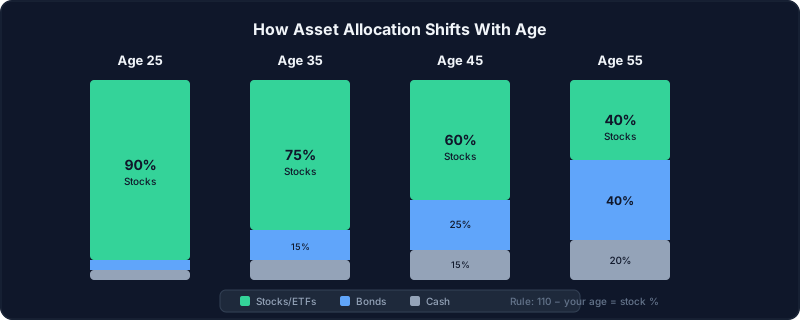
- Age 25: 110 - 25 = 85-90% stocks. You have decades to recover from any crash.
- Age 35: 110 - 35 = 75% stocks. Still growth-focused, with some stability.
- Age 45: 110 - 45 = 65% stocks. More balance as retirement approaches.
- Age 55: 110 - 55 = 55% stocks. Capital preservation becomes more important.
This is a guideline, not a law. Your personal situation — income, expenses, risk tolerance, other assets — should override any formula.
Why Age Matters
The logic is straightforward:
When you're young (20s-30s):
- You have 30-40 years of investing ahead
- Market crashes are buying opportunities, not emergencies
- You're still earning income to offset any losses
- Time heals all market wounds — even the 2008 crash recovered within 5 years
When you're older (50s-60s):
- You may need this money within 10-15 years
- A 40% market crash could delay retirement by years
- You have less time and less income to recover
- Capital preservation outweighs capital growth
Beyond the Rule: What Really Matters
The 110-minus-age rule is a starting point. Here's what should actually drive your allocation:
1. Your time horizon — When do you need the money? If it's 20+ years, go heavy on stocks regardless of age. If it's 5 years, lean toward bonds.
2. Your income stability — A tenured professor can afford more risk than a freelancer with variable income.
3. Your other assets — If you own property, you already have real estate exposure. Your total net worth matters, not just your investment portfolio.
4. Your emotional tolerance — Can you watch your portfolio drop 30% without selling? If not, reduce stocks until you find your comfort level.
5. Your pension/retirement system — Europeans with strong state pensions can afford more stock exposure because their baseline retirement is secured.
Rebalancing: The Maintenance Step
As markets move, your allocation drifts. If stocks have a great year, they might grow from 70% to 80% of your portfolio. You need to rebalance — sell some stocks, buy bonds — to return to your target.
How often? Once a year is enough. Pick a date (birthday, New Year's, tax season) and make it a habit. Over-rebalancing (monthly or quarterly) adds costs without meaningful benefit.
The Glide Path Approach
Instead of abrupt changes, gradually reduce stock exposure by 1-2% per year. This creates a "glide path" toward retirement:
| Age | Stock % | Bond % | Cash % | Annual Shift |
|---|---|---|---|---|
| 25 | 90% | 5% | 5% | Start here |
| 35 | 75% | 15% | 10% | -1.5%/year stocks |
| 45 | 60% | 25% | 15% | -1.5%/year stocks |
| 55 | 45% | 35% | 20% | -1.5%/year stocks |
| 65 | 30% | 45% | 25% | Capital preservation |
This smooth transition prevents the emotional difficulty of making large allocation changes all at once.
See It for Yourself
Model your current allocation in our simulator and project how it grows over your remaining investment horizon. Then try adjusting the mix — see what happens when you shift 10% from stocks to bonds, or vice versa. The visual comparison makes the trade-off concrete.
Ready to project your portfolio growth?
Try our free simulator — add your assets, set contributions, and see how your investments could grow.
Try the Simulator