Best ETFs for European Investors in 2026
With thousands of ETFs available, choosing the right ones can feel overwhelming. This guide cuts through the noise and highlights the ETFs that matter most for European investors — focusing on low cost, broad diversification, and proven track records.
Top ETFs at a Glance
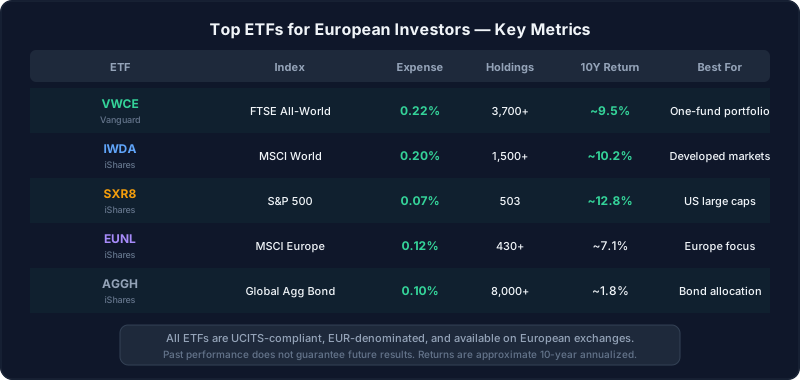
All of these are UCITS-compliant (required for EU investors), EUR-denominated or EUR-hedged, and available on major European exchanges (Xetra, Euronext, Borsa Italiana).
The One-ETF Portfolio: VWCE
If you could only buy one ETF, Vanguard FTSE All-World (VWCE) is the strongest candidate. It gives you:
- Exposure to 3,700+ companies across 50 countries
- Both developed and emerging markets in one fund
- Automatic rebalancing as markets shift
- 0.22% annual cost — that's €22/year on a €10,000 investment
It's the "set and forget" choice. One purchase, instant global diversification.
For US Market Exposure: SXR8
The iShares Core S&P 500 (SXR8) tracks the 500 largest US companies. At just 0.07% expense ratio, it's one of the cheapest ETFs in existence.
Use this if you want heavy US exposure or believe US markets will continue to outperform. Pair it with a European ETF for geographic balance.
For European Focus: EUNL
iShares MSCI Europe (EUNL) gives you pure European exposure — 430+ companies across 15 European countries. Lower historical returns than the S&P 500, but it provides home-region allocation without currency risk.
Good as a complement to a US-heavy portfolio, or as a core holding for investors who prefer European companies.
For Bonds: AGGH
iShares Core Global Aggregate Bond (AGGH) covers the entire investment-grade bond universe — government and corporate bonds worldwide. At 0.10% expense ratio, it's your stability anchor.
Use this for the bond portion of your portfolio. It won't generate exciting returns, but it cushions your portfolio during stock market downturns.
What Makes a Good ETF?
When evaluating any ETF, check these five criteria:
- Expense ratio — Lower is better. Under 0.30% for stock ETFs, under 0.15% for bond ETFs
- Tracking error — How closely does it follow its index? Lower = better
- Fund size — Larger funds are more liquid and less likely to close. Look for €1B+ AUM
- Replication method — Physical (actually holds the stocks) is preferred over synthetic
- Distribution — Accumulating (reinvests dividends) is usually more tax-efficient in Europe
Sample Portfolios Using These ETFs
The Minimalist (1 ETF):
- 100% VWCE
The Balanced (2 ETFs):
- 80% VWCE + 20% AGGH
The Customized (3 ETFs):
- 50% IWDA + 20% SXR8 + 30% AGGH
The European-Tilted (3 ETFs):
- 40% EUNL + 40% SXR8 + 20% AGGH
UCITS: Why It Matters
European regulations require retail investors to buy UCITS-compliant funds. This means you generally can't buy US-domiciled ETFs (like SPY or VTI) directly. Instead, look for the European-listed equivalents — they track the same indices but comply with EU regulations.
All ETFs listed in this article are UCITS-compliant.
See It for Yourself
Pick any combination from these ETFs, set your monthly contribution, and project the growth over your investment horizon in our simulator. Compare a one-ETF approach against a multi-ETF strategy and see which fits your goals.
Ready to project your portfolio growth?
Try our free simulator — add your assets, set contributions, and see how your investments could grow.
Try the Simulator