Dollar-Cost Averaging: The Strategy That Removes Emotion from Investing
Every investor has the same fear: what if I invest today and the market drops tomorrow? Dollar-cost averaging (DCA) is the strategy that makes this fear irrelevant. Instead of trying to pick the perfect moment, you invest a fixed amount at regular intervals — and let time do the work.
How Dollar-Cost Averaging Works
The concept is simple: invest the same amount every month, regardless of what the market is doing. When prices are high, your fixed amount buys fewer shares. When prices are low, it buys more shares. Over time, this naturally lowers your average cost per share.
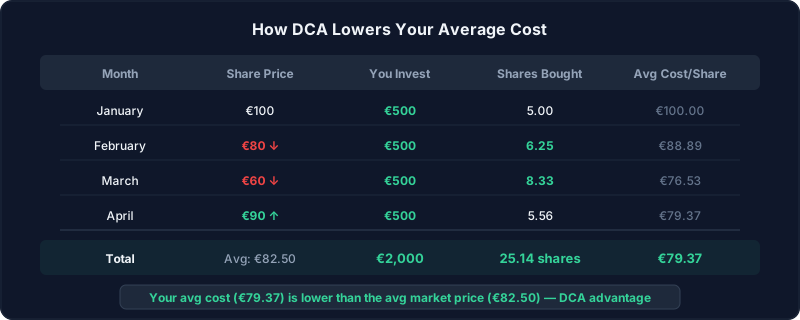
Notice that your average cost (€79.37) is lower than the average market price (€82.50). That's the DCA advantage — by buying more shares when they're cheap, you tilt the math in your favor without needing to predict anything.
DCA vs. Lump Sum Investing
The honest truth: in a steadily rising market, lump sum investing usually beats DCA because your money is working for longer. But markets don't rise steadily — they crash, recover, crash again, and eventually trend upward.
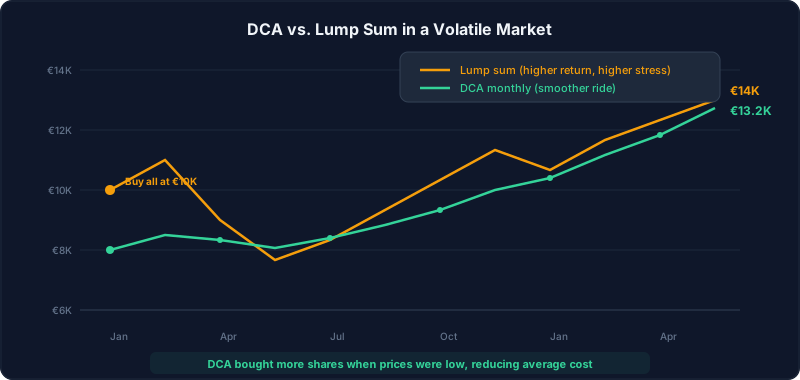
In volatile markets, DCA provides a smoother psychological experience. The lump sum investor watched their portfolio drop 30% in month four and had to resist panic selling. The DCA investor was buying bargains during the dip.
DCA doesn't maximize returns — it maximizes the probability that you stay invested. And staying invested is what matters most.
Why Timing the Market Fails
To time the market successfully, you need to be right twice: when to sell AND when to buy back in. Research from JP Morgan shows that missing just the 10 best trading days in a 20-year period cuts your returns by more than half.
Those best days often come right after the worst days — exactly when fear tells you to stay out.
| Strategy | €10,000 invested over 20 years |
|---|---|
| Stayed fully invested | €64,844 |
| Missed the 10 best days | €29,708 |
| Missed the 20 best days | €17,826 |
| Missed the 30 best days | €11,556 |
DCA removes the temptation to time. You invest on schedule, every month, rain or shine. No decisions, no stress, no missed days.
The Psychological Advantage
The biggest enemy of investment returns isn't fees or bad picks — it's investor behavior. Studies show the average investor earns significantly less than the market because they:
- Buy when prices are high (euphoria)
- Sell when prices are low (panic)
- Sit in cash waiting for the "right moment" (fear)
DCA eliminates all three. It's mechanical, automatic, and emotion-free. You set up a monthly contribution and stop thinking about it.
How to Implement DCA
- Choose your amount. Pick what you can invest every month without financial stress. Even €100/month works.
- Set a schedule. Monthly is most common. Pick a day (e.g., 1st of each month) and stick to it.
- Automate it. Most brokers let you set up automatic recurring investments. Remove yourself from the equation.
- Don't check daily. Check your portfolio quarterly at most. DCA rewards patience, not attention.
- Never skip a month — especially when markets are down. That's when DCA does its best work.
When DCA Doesn't Make Sense
DCA is not always optimal:
- If you have a large lump sum and the market is trending upward, investing it all at once statistically produces higher returns about 66% of the time.
- If you're investing in assets with no volatility (like savings accounts), there's nothing to average.
- If your time horizon is very short (under 2 years), market fluctuations may not have time to smooth out.
For most people investing for retirement or long-term goals, DCA is the right default strategy.
See It for Yourself
Set up a simulation with regular monthly contributions and see how DCA compounds your wealth over 10, 20, or 30 years. Our simulator shows you exactly how each contribution builds on the last.
Ready to project your portfolio growth?
Try our free simulator — add your assets, set contributions, and see how your investments could grow.
Try the Simulator