How Long Does It Take to Double Your Money?
"How long until my money doubles?" It's one of the most powerful questions in investing — and there's a beautifully simple formula that answers it instantly.
The Rule of 72
Divide 72 by your annual return rate. That's how many years it takes to double.
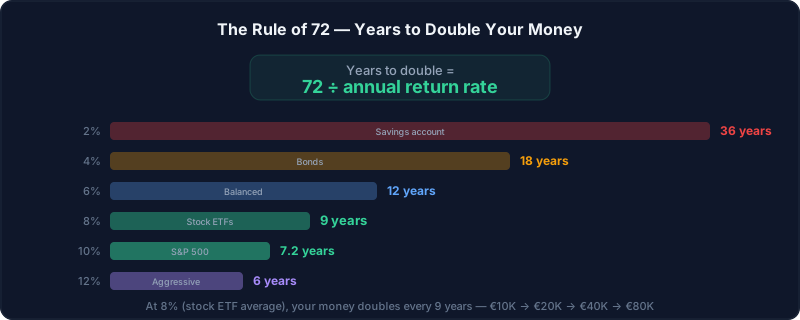
At 8% — the long-term average for global stock ETFs — your money doubles every 9 years. At a savings account rate of 2%, it takes 36 years. That's a 4× difference in speed.
72 ÷ 8 = 9 years. That's it. No spreadsheet needed.
The Doubling Chain: Why Each One Matters More
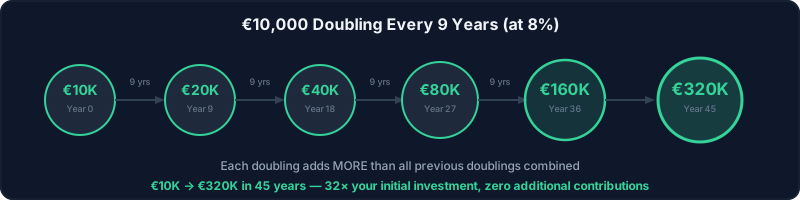
Here's what makes compound interest extraordinary: each doubling adds more money than all previous doublings combined. Starting with €10,000 at 8%:
| Doubling | From → To | Money Added | Total Time |
|---|---|---|---|
| 1st | €10K → €20K | €10,000 | 9 years |
| 2nd | €20K → €40K | €20,000 | 18 years |
| 3rd | €40K → €80K | €40,000 | 27 years |
| 4th | €80K → €160K | €80,000 | 36 years |
| 5th | €160K → €320K | €160,000 | 45 years |
The 5th doubling adds €160,000 — sixteen times more than the 1st doubling. Same percentage, same time period, massively different absolute numbers. That's why the final years of compounding are the most valuable.
Doubling With Monthly Contributions
The Rule of 72 applies to lump sums. With monthly contributions, your effective doubling time is faster because new money keeps entering:
| Monthly | Starting | Double Target | Time to Reach (8%) |
|---|---|---|---|
| €0 | €10,000 | €20,000 | 9.0 years |
| €100 | €10,000 | €20,000 | 5.2 years |
| €250 | €10,000 | €20,000 | 3.4 years |
| €500 | €10,000 | €20,000 | 2.3 years |
With €500/month contributions, you reach €20,000 in just 2.3 years instead of 9. Contributions accelerate the early doublings dramatically.
What the Rule of 72 Tells You About Asset Choice
The Rule of 72 makes the cost of low returns viscerally clear:
- Savings account at 1%: Doubles in 72 years. You'll be dead before it doubles.
- Government bonds at 3%: Doubles in 24 years. One doubling in a career.
- Stock ETFs at 8%: Doubles in 9 years. Four doublings in a career (16× your money).
- S&P 500 at 10%: Doubles in 7.2 years. Five doublings in a career (32× your money).
The difference between 3% and 8% isn't "a bit more return." It's the difference between 2× and 16× your money over a 36-year career.
Using the Rule of 72 for Inflation
The rule works in reverse too. At 2% inflation, your purchasing power halves every 36 years. At 5% inflation, it halves every 14.4 years.
This is why "keeping money safe" in a savings account isn't actually safe. Your money doubles nominally in 72 years at 1%, but your purchasing power halves in 36 years at 2% inflation. You're going backward.
The Rule of 72 for Goal Planning
Use it to quickly sanity-check any financial plan:
- "I have €50K and want €200K" → That's 2 doublings → 18 years at 8%
- "I have €100K and want €1M" → That's ~3.3 doublings → ~30 years at 8%
- "I want to turn €10K into €100K" → That's ~3.3 doublings → ~30 years at 8%
These are approximations, but they're remarkably close to the exact math — and you can do them in your head.
See It for Yourself
Enter your current portfolio value in our simulator, set your expected return, and watch the doubling chain unfold year by year. Add monthly contributions to see how much faster you reach each milestone.
Ready to project your portfolio growth?
Try our free simulator — add your assets, set contributions, and see how your investments could grow.
Try the Simulator