Investing in Europe: EUR vs USD Portfolios
As a European investor, you face a question that Americans don't: should you invest in EUR or USD? The US stock market has historically outperformed Europe, but investing in USD introduces currency risk. Let's break down the trade-offs.
EUR vs USD — Side by Side
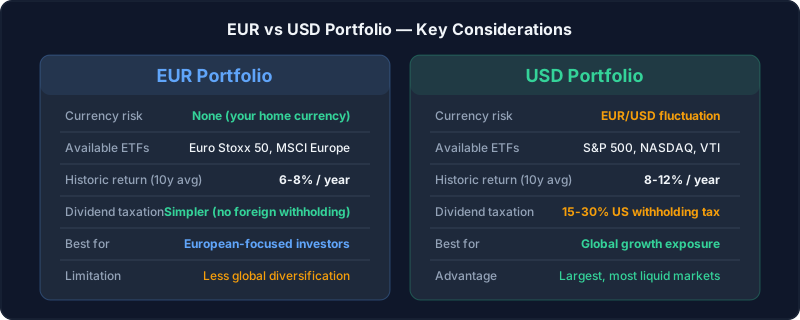
Neither is categorically better. The right choice depends on your goals, time horizon, and how much currency risk you're comfortable with.
Understanding Currency Risk
When you — a EUR-based investor — buy a USD-denominated ETF, your returns depend on two things:
- How the ETF performs (e.g., S&P 500 goes up 10%)
- How EUR/USD moves (e.g., USD weakens 5% against EUR)
In this example, your actual return in EUR is closer to 5%, not 10%. Currency fluctuations can boost or erode your returns by 5-10% in any given year.
Over 20+ years, currency effects tend to average out. Short-term, they add volatility. Long-term, the underlying asset performance dominates.
The Case for EUR-Only
If you're investing for goals denominated in EUR (retirement in Europe, buying a house in Europe), a EUR portfolio has advantages:
- No currency conversion costs when you withdraw
- Simpler tax reporting — no foreign tax credits to claim
- Predictable purchasing power — your portfolio value in EUR is your actual wealth
European ETFs to consider: Euro Stoxx 50, MSCI Europe, FTSE Developed Europe.
The Case for USD Exposure
The US market represents ~60% of global market capitalization. Excluding it means missing the world's largest, most innovative companies:
- Higher historical returns — US markets have outperformed Europe over the last 20 years
- Better diversification — different economic cycles than Europe
- Access to sectors underrepresented in Europe (big tech, biotech)
Many European-listed ETFs track US indices but are denominated in EUR (e.g., iShares Core S&P 500 UCITS ETF). These eliminate conversion hassle but still carry currency risk.
The Practical Solution: Global ETFs
The simplest approach for European investors is a global ETF — one fund that includes both US and European stocks, weighted by market cap:
- Vanguard FTSE All-World (VWCE) — 3,700+ companies, ~60% US, ~16% Europe, ~10% Asia
- iShares MSCI ACWI — similar global coverage
You get natural currency diversification without having to manage it yourself. The fund handles rebalancing across regions.
| Approach | Complexity | Currency Risk | Diversification |
|---|---|---|---|
| EUR-only ETFs | Low | None | Limited to Europe |
| USD-only ETFs | Low | High | Limited to US |
| Global ETF | Low | Mixed (natural) | Maximum |
| Multi-currency mix | High | Managed | Customizable |
Tax Considerations for Europeans
European investors face different tax treatments depending on their country:
- Germany: 26.375% flat tax on capital gains (Abgeltungsteuer)
- France: 30% flat tax (PFU) or progressive scale
- Switzerland: No capital gains tax on private investments
For US dividends, a 15% withholding tax is typically deducted at source (under most EU-US tax treaties). This can often be credited against your domestic tax liability, but it adds complexity.
EUR-denominated funds simplify this significantly.
See It for Yourself
Model both a EUR-focused and a mixed EUR/USD portfolio in our simulator. Compare how they grow over your time horizon with different currency assumptions. Our multi-currency support lets you track each asset in its own currency while seeing the total in yours.
Ready to project your portfolio growth?
Try our free simulator — add your assets, set contributions, and see how your investments could grow.
Try the Simulator