Investment Growth Calculator: Estimate Your Portfolio Value
How much will your investments be worth in 10 years? 20? 30? An investment growth calculator answers this question in seconds — and the answer often changes how you think about money.
The 4 Inputs That Drive Everything
Every investment growth calculation comes down to four numbers:
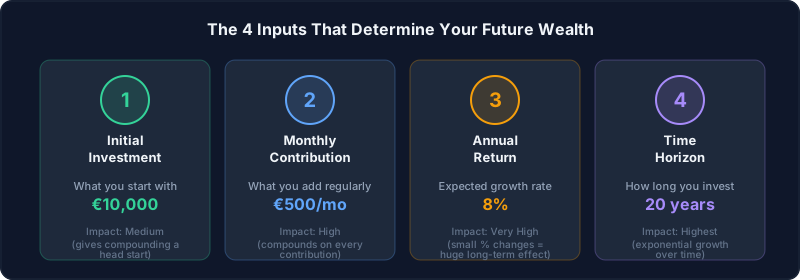
Change any one of these and the outcome shifts dramatically. But not all inputs are equal — time and return rate have exponential effects, while initial investment and contributions have linear effects.
Quick Reference: Common Scenarios
Here are pre-calculated results for the most common investment situations:
| Monthly | Return | 10 Years | 20 Years | 30 Years |
|---|---|---|---|---|
| €100 | 8% | €18,295 | €58,902 | €149,036 |
| €250 | 8% | €45,737 | €147,255 | €372,590 |
| €500 | 8% | €91,473 | €294,510 | €745,180 |
| €1,000 | 8% | €182,946 | €589,020 | €1,490,360 |
| €2,000 | 8% | €365,893 | €1,178,041 | €2,980,720 |
Notice the pattern: doubling your monthly investment exactly doubles your final value. But doubling your time horizon more than quadruples it.
Why Most Online Calculators Mislead You
Most investment calculators show you a single number — "Your portfolio will be worth €1.49M!" They leave out critical context:
1. They ignore inflation. €1.49M in 30 years buys what ~€813K buys today at 2% inflation. Always calculate in real (inflation-adjusted) terms.
2. They assume constant returns. Markets don't deliver exactly 8% every year. Real returns zigzag — but the long-term average holds for diversified index funds.
3. They don't show the journey. A good calculator shows you year-by-year projections, not just the endpoint. Seeing the growth curve helps you understand when compound interest takes over.
4. They ignore taxes. Returns are pre-tax. Depending on your country, capital gains taxes reduce your effective return by 1-2%.
How to Use a Growth Calculator Effectively
Step 1: Start with your goal, not your contribution. "I want €500,000 in 20 years" is more useful than "I'll invest €500/month and see what happens." Work backward from the goal.
Step 2: Run three scenarios. Conservative (6%), realistic (8%), and optimistic (10%). If your plan works at 6%, you're in great shape.
Step 3: Include inflation. Set a 2% inflation rate to see your portfolio's real purchasing power, not just its nominal value.
Step 4: Model contribution increases. If you plan to increase your monthly investment by 3-5% annually (matching salary growth), factor that in. It makes a massive difference.
Step 5: Revisit annually. Replace your projected starting value with your actual portfolio value and recalculate. This keeps your projections grounded in reality.
The Power of Small Changes
Small tweaks to your inputs create surprisingly large differences over time:
| Change | Impact on 30-Year Value (base: €500/mo, 8%) |
|---|---|
| +€100/month | +€149,036 (+20%) |
| +1% return (9% instead of 8%) | +€185,000 (+25%) |
| +5 years (35y instead of 30y) | +€402,000 (+54%) |
| Start with €10K lump sum | +€100,627 (+13%) |
The highest-impact change? More time. Adding 5 years is worth more than adding €100/month or finding an extra 1% return.
See It for Yourself
Stop guessing and start calculating. Our free simulator lets you model any scenario — multiple assets, different return rates, monthly contributions, inflation adjustment. See your projected portfolio value year by year, with a clear breakdown of contributions vs. compound interest gains.
Ready to project your portfolio growth?
Try our free simulator — add your assets, set contributions, and see how your investments could grow.
Try the Simulator