What Is Portfolio Diversification and Why It Matters
"Don't put all your eggs in one basket." It's the oldest advice in investing — and it's still the most important. Portfolio diversification is the practice of spreading your investments across different assets so that a loss in one doesn't devastate your entire portfolio.
Why Diversification Works
Every asset class behaves differently under different market conditions:
| Market Condition | Stocks | Bonds | Real Estate | Cash |
|---|---|---|---|---|
| Economic boom | Strong gains | Moderate | Strong | Low |
| Recession | Sharp losses | Often gains | Mixed | Stable |
| High inflation | Mixed | Losses | Often gains | Loses value |
| Market crash | Heavy losses | Flight to safety | Delayed impact | Stable |
When one asset falls, another often holds steady or rises. This isn't about avoiding all losses — it's about reducing the severity of any single loss and smoothing your returns over time.
The Math Behind Diversification
Consider two scenarios over 5 years:
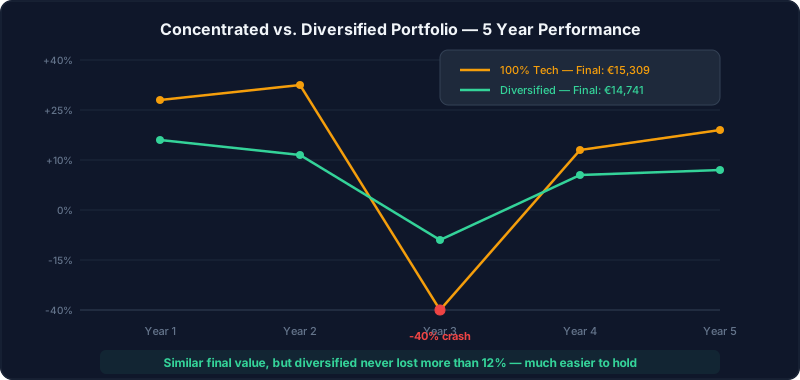
Portfolio A — 100% tech stocks: Year 1: +30%, Year 2: +25%, Year 3: -40%, Year 4: +20%, Year 5: +15% Final value of €10,000: €15,309
Portfolio B — 50% stocks, 30% bonds, 20% ETFs: Year 1: +18%, Year 2: +14%, Year 3: -12%, Year 4: +11%, Year 5: +10% Final value of €10,000: €14,741
Portfolio A has a slightly higher final value — but it also had a year where you lost 40% of your money. Most investors panic and sell during that year, locking in their losses. Portfolio B never lost more than 12%, making it far easier to stay the course.
The best portfolio isn't the one with the highest theoretical return — it's the one you can actually stick with.
Types of Diversification
1. Across Asset Classes
The most fundamental form. Mix stocks, bonds, ETFs, cash, and real estate. Each responds differently to market conditions.
2. Within Asset Classes
Don't buy just one stock — spread across sectors (technology, healthcare, energy, consumer goods). An index fund or ETF does this automatically.
3. Geographic Diversification
Don't concentrate in one country's market. A mix of US, European, and emerging market exposure protects against regional economic downturns.
4. Time Diversification
Invest regularly over time rather than all at once. This is dollar-cost averaging — it smooths out the impact of market timing.
Common Diversification Mistakes
1. Over-diversification. Owning 50 different funds that all track similar indices gives you complexity without benefit. 5-10 well-chosen, uncorrelated assets is usually sufficient.
2. Diversifying only within stocks. Holding 20 different tech stocks isn't diversification — they'll all fall together in a tech downturn. True diversification means mixing asset types.
3. Ignoring correlation. Two assets that always move in the same direction don't diversify each other. The key is finding assets with low or negative correlation.
4. Never rebalancing. Over time, your winners grow and your portfolio drifts from its target allocation. Annual rebalancing keeps your risk level where you want it.
A Simple Diversification Framework
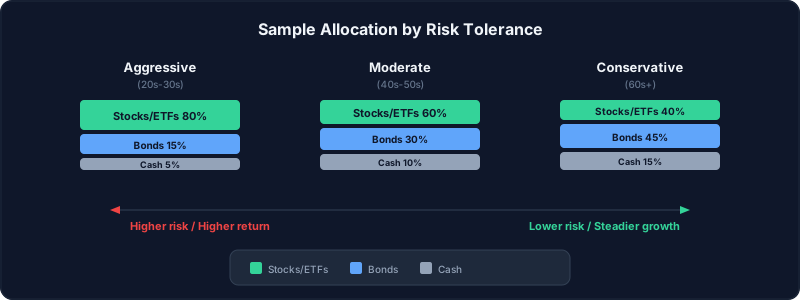
If you're starting out, a straightforward allocation might look like:
| Risk Tolerance | Stocks/ETFs | Bonds | Cash |
|---|---|---|---|
| Aggressive (20s-30s) | 80% | 15% | 5% |
| Moderate (40s-50s) | 60% | 30% | 10% |
| Conservative (60s+) | 40% | 45% | 15% |
These are starting points, not rules. Your personal situation — income stability, financial goals, risk appetite — should drive the final allocation.
Track Your Diversification
Knowing your allocation on paper is one thing. Seeing how each asset contributes to your total portfolio value — and projecting where it'll be in 10 or 20 years — gives you the confidence to stay diversified even when one asset class is outperforming everything else.
Try our simulator to model different diversification strategies and see how they perform over time.
Ready to project your portfolio growth?
Try our free simulator — add your assets, set contributions, and see how your investments could grow.
Try the Simulator