How to Project Your Portfolio Growth Over 10, 20, 30 Years
Investing without projecting is like driving without a map. You know you're moving, but you have no idea when you'll arrive — or if you're even going in the right direction. Portfolio projections give you that map.
The 4 Variables That Determine Everything
Your future portfolio value depends on exactly four inputs. Everything else is noise.
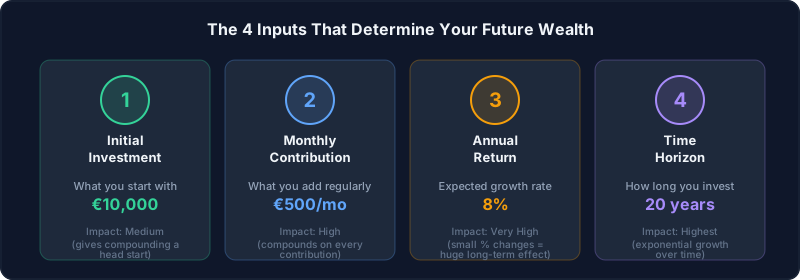
Of these four, time has the most dramatic impact. A 10-year difference in time horizon can triple or quadruple your final wealth — even with identical contributions and returns.
Running the Numbers
Let's project three real scenarios with the same total contribution of €60,000:
| Scenario | Initial | Monthly | Return | Years | Final Value |
|---|---|---|---|---|---|
| A: Lump sum, wait | €60,000 | €0 | 8% | 20 | €279,657 |
| B: Steady DCA | €0 | €250 | 8% | 20 | €147,255 |
| C: Both combined | €10,000 | €208 | 8% | 20 | €168,627 |
Scenario A wins because the entire amount compounds for the full 20 years. But most people don't have €60,000 to invest at once. Scenario C — starting with what you have and adding monthly — is the realistic sweet spot.
Why Projections Matter
Projections aren't predictions — they're planning tools. They help you answer critical questions:
- "Am I saving enough to retire at 60?"
- "How much do I need to invest monthly to reach €500,000?"
- "What happens if my returns are 6% instead of 8%?"
- "How much of my wealth is from contributions vs. compound interest?"
Running these scenarios prevents the two biggest mistakes: investing too little (because you didn't realize how much compound interest helps) and expecting too much (because you used unrealistic return assumptions).
Choosing Realistic Return Assumptions
The return you plug into your projection matters enormously. Here's what history tells us:
| Asset Type | Conservative | Realistic | Optimistic |
|---|---|---|---|
| Global stock ETF | 6% | 8% | 10% |
| Bond ETF | 2% | 3.5% | 5% |
| Balanced portfolio | 4% | 6% | 8% |
| Savings account | 0.5% | 1% | 2% |
Always project with at least two return scenarios — a realistic one and a conservative one. If your plan works even in the conservative case, you're in good shape.
Don't Forget Inflation
A projection showing €1 million in 30 years sounds incredible — until you realize that €1 million in 2056 buys what ~€545,000 buys today (at 2% inflation). Always look at inflation-adjusted projections to understand your real future wealth.
How to Use Projections Effectively
-
Start with your goal. "I want €300,000 for retirement in 25 years." Work backward to find the monthly contribution needed.
-
Run multiple scenarios. What if returns are 6% instead of 8%? What if you increase contributions by 3% annually? What if you start 5 years later?
-
Update annually. Your actual returns will differ from projections. Recalculate each year with your real portfolio value as the new starting point.
-
Include inflation. Always. A nominal projection is misleading over long periods.
-
Don't micro-optimize. The difference between 7.5% and 8.2% returns is less important than actually investing consistently. Get the big picture right.
See It for Yourself
Our simulator lets you project any combination of assets with custom returns, monthly contributions, and time horizons. Add inflation, compare scenarios, and see exactly where your portfolio could be in 10, 20, or 30 years. It takes 30 seconds — and the clarity it provides is worth hours of reading.
Ready to project your portfolio growth?
Try our free simulator — add your assets, set contributions, and see how your investments could grow.
Try the Simulator