Setting Up Recurring Contributions: Why Automation Wins
The most successful investors share one trait: they automate. Instead of deciding each month whether to invest (and how much), they set up a recurring contribution and let it run. This removes willpower, timing, and emotion from the equation.
How Recurring Contributions Work
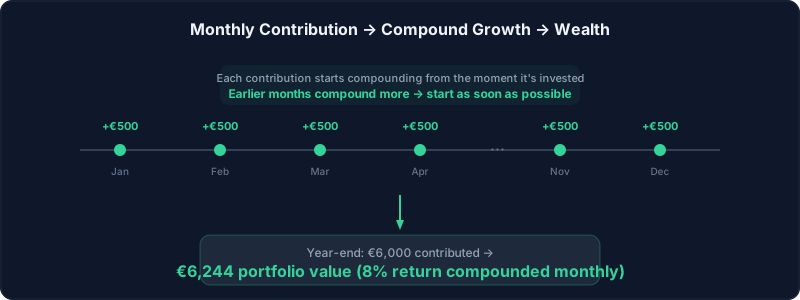
Every €500 you invest starts compounding from the moment it lands. January's contribution has 12 months to grow. December's contribution has 1 month. Over years, these individual contributions stack up — each building on all the ones before it.
Why Automation Beats Willpower
Behavioral economics shows that investing decisions suffer from predictable biases:
- Loss aversion: Markets are down → "I'll wait for a recovery" → miss the bottom
- Overconfidence: Markets are up → "I'll invest more now" → buy at the peak
- Present bias: "I need that money for something else this month" → never invest
Automation eliminates all three. The money moves before you can overthink it.
| Approach | Avg Annual Return | Reason |
|---|---|---|
| Automated monthly | ~8% (market average) | Buys consistently, captures all returns |
| Manual "when I feel like it" | ~5-6% | Misses dips, over-invests at peaks |
| Waiting for the "right time" | ~2-3% | Cash drag while waiting |
The gap between automated and manual investing is 2-4% annually. Over 30 years, that's the difference between €745K and €450K on €500/month.
Setting Up Your Recurring Contribution
For your brokerage account:
- Log in to your broker (Trade Republic, Scalable Capital, DEGIRO, etc.)
- Find the "Savings Plan" or "Recurring Investment" option
- Choose your ETF(s)
- Set amount (e.g., €500) and frequency (monthly)
- Pick a day (1st of month is most common)
- Confirm and forget
For Likafi: Once you've created a portfolio, you can set up recurring contribution tracking for each asset. This lets you see exactly how your contributions compound over time and project future values.
How Much to Contribute
A common question with a simple answer: as much as you can afford consistently. The rules of thumb:
- Minimum: 10% of your net income
- Comfortable: 15-20% of net income
- Aggressive: 30%+ of net income (for those targeting early financial independence)
It's better to start with €100/month consistently than €500/month that you'll stop after 3 months because it's too much.
Increasing Contributions Over Time
The most powerful move: increase your contribution by 3-5% every year, matching salary growth. This has an outsized impact because each increase compounds for all future years.
| Strategy | Monthly at Start | Monthly at Year 10 | Value at Year 30 |
|---|---|---|---|
| Fixed €500/month | €500 | €500 | €745K |
| 3% annual increase | €500 | €672 | €1.05M |
| 5% annual increase | €500 | €814 | €1.38M |
That 3% annual increase — barely noticeable each year — adds €305,000 to your final wealth.
Common Mistakes
Stopping during market downturns. This is the worst time to stop. You're buying shares at a discount. Keep contributing.
Setting contributions too high. If you can't sustain it, you'll quit entirely. Start lower, increase later.
Not tracking contributions. Without visibility into how your contributions grow, you lose the motivation that keeps you going. Track every contribution, see the compounding effect, and watch your portfolio grow month by month.
See It for Yourself
Set up a simulation with monthly contributions and watch how each one stacks on the last. Our simulator shows you the projected value year by year — and the growing gap between what you put in and what compound interest adds on top.
Ready to project your portfolio growth?
Try our free simulator — add your assets, set contributions, and see how your investments could grow.
Try the Simulator