Why You Should Track Every Asset in Your Portfolio
Here's an uncomfortable truth: most people have no idea how their investments are actually performing. They know they "put money in" and hope it's growing. That's not investing — that's hoping. Real investing requires visibility.
What Tracking Reveals
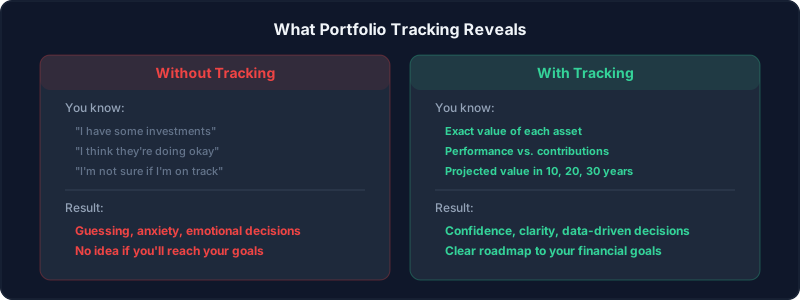
Without tracking, you're making decisions based on feelings. With tracking, you're making decisions based on data. The difference compounds over decades — just like your returns.
The 5 Things Worth Tracking
1. Total Portfolio Value Over Time
The big picture. Is your portfolio growing? At what rate? Is it accelerating (compound interest working) or stalling (contributions too low)?
A simple chart of portfolio value over time is the most motivating tool an investor has. Seeing the line go up — even during months when you didn't contribute — proves that your money is working for you.
2. Per-Asset Performance
Not all assets perform equally. Your S&P 500 ETF might be up 12% while your European bonds are flat. Tracking each asset individually tells you:
- Which assets are pulling their weight
- Which are underperforming relative to expectations
- Whether your allocation has drifted from your target
3. Contributions vs. Growth
The most powerful insight: how much of your wealth is from what you put in vs. what compound interest generated? Early in your investing journey, contributions dominate. Over time, growth takes over. Watching this crossover happen is incredibly motivating.
4. Projected Future Value
Where will you be in 10 years at your current pace? 20 years? Is it enough for your goals? Projections turn abstract goals ("I want to retire comfortably") into concrete numbers ("I need €800,000, and at my current rate I'll have €750,000 — I need to increase contributions by €50/month").
5. Recurring Contribution Impact
Each monthly contribution compounds differently — January's €500 has more time to grow than December's. Tracking contributions shows you how each one builds on the last and motivates you to keep going.
Why Most People Don't Track
It seems unnecessary. "The money's in an ETF, it's growing, why bother?" Because without tracking, you can't answer: Is it growing fast enough? Am I on target? Should I adjust?
It seems complicated. Spreadsheets, multiple broker accounts, currency conversions, contribution history — it's a lot. That's exactly why purpose-built tools exist.
It triggers anxiety. Some investors avoid looking at their portfolio because they're afraid of what they'll see. But ignorance doesn't prevent losses — it prevents timely adjustments.
You can't improve what you don't measure. Tracking isn't about obsessing over daily fluctuations — it's about having a clear picture of where you are and where you're going.
What Good Tracking Looks Like
Effective portfolio tracking should show you:
- Current value of every asset, in your base currency
- Historical performance over time (not just today's number)
- Contribution history — what you put in vs. what the market generated
- Growth projections based on your current pace
- Asset allocation breakdown (are you still balanced?)
It should be effortless to maintain. If tracking requires an hour of spreadsheet work every month, you'll stop doing it. The best tracking is automatic — input your assets once, set your contributions, and watch the dashboard update.
The Behavioral Benefit
Investors who track their portfolios consistently make better decisions:
- They contribute more regularly — seeing growth motivates continued investment
- They panic less during downturns — historical context shows that dips are normal
- They rebalance more effectively — drift is visible at a glance
- They reach goals faster — course corrections happen early, not when it's too late
See It for Yourself
Start tracking your portfolio with Likafi. Add your assets, set up recurring contributions, and get instant projections of where your investments could be in 5, 10, or 30 years. The visibility alone will change how you think about your financial future.
Ready to project your portfolio growth?
Try our free simulator — add your assets, set contributions, and see how your investments could grow.
Try the Simulator