Understanding Inflation and How to Protect Your Portfolio
Most people think of risk as their investments going down. But there's a bigger risk that gets far less attention: inflation silently eating your savings. Every year, the same amount of money buys less. If your money isn't growing faster than inflation, you're getting poorer.
The Silent Tax on Your Savings
At 2% annual inflation — the European Central Bank's target — here's what happens to €10,000 if you leave it in a bank account earning near 0%:
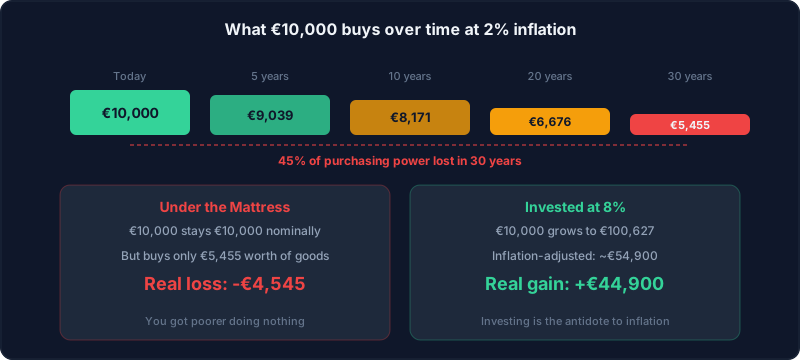
You still have €10,000 in the bank. It still says €10,000 on the screen. But what it can buy has dropped to €5,455 worth of goods. That's not a market crash — that's just time passing.
Not investing isn't "playing it safe." It's choosing a guaranteed loss of purchasing power.
Nominal vs. Real Returns
Every return you see is a nominal return — before inflation. To know your actual wealth gain, you need to subtract inflation:
| Return Type | Value |
|---|---|
| Nominal return (what your broker shows) | 8% |
| Inflation rate | 2% |
| Real return (your actual wealth gain) | ~6% |
This is why our simulator includes an inflation adjustment option. Seeing your portfolio in real (inflation-adjusted) terms gives you a much more honest picture of your future wealth.
Which Assets Beat Inflation?
Not all investments protect equally against inflation:
| Asset | Typical Return | Beats 2% Inflation? | Notes |
|---|---|---|---|
| Savings account | 0-1% | No | Guaranteed loss |
| Government bonds | 2-4% | Barely | Breaks even at best |
| Stock market ETFs | 7-10% | Yes | Best long-term hedge |
| Real estate | 5-8% | Yes | Illiquid but inflation-resistant |
| Cash under mattress | 0% | No | Worst option |
The pattern is clear: equities are the most reliable long-term inflation hedge. Over any 20-year period in market history, a diversified stock portfolio has outpaced inflation.
High-Inflation Environments
During periods of unusually high inflation (4-8%+), the dynamics shift:
- Stocks: Short-term volatility, but companies raise prices, so revenues eventually keep up
- Bonds: Lose value as interest rates rise to combat inflation
- Cash: Loses purchasing power rapidly
- Real assets (property, commodities): Tend to hold value or appreciate
The lesson: even in high-inflation environments, staying invested in diversified equities is better than holding cash. You might lose 10% in a stock market dip, but you'll lose purchasing power for certain if you hold cash.
The Rule of 72
A quick mental shortcut: divide 72 by the inflation rate to see how many years it takes to halve your purchasing power.
- At 2% inflation: 72 ÷ 2 = 36 years to lose half your buying power
- At 3% inflation: 72 ÷ 3 = 24 years
- At 5% inflation: 72 ÷ 5 = 14.4 years
The same rule works for returns: at 8% return, your money doubles every 9 years (72 ÷ 8 = 9).
Protecting Your Portfolio
- Stay invested in equities. Over long periods, stocks beat inflation consistently
- Use real return in your planning. Our simulator lets you set an inflation rate — use it
- Don't hoard cash beyond your emergency fund. Cash is for short-term needs, not long-term wealth
- Increase contributions over time. As your salary grows, increase your monthly investment to at least match inflation
See It for Yourself
Try our simulator with the inflation adjustment enabled. Enter your assets, set a 2% inflation rate, and compare the nominal vs. real projected values. It's an eye-opener — and the best motivation to start investing now rather than later.
Ready to project your portfolio growth?
Try our free simulator — add your assets, set contributions, and see how your investments could grow.
Try the Simulator